Snake on the house? Most Florida snakes are rodent-eating neighbors best left alone
A snake photographed climbing a brick wall at a Brevard County home appears to be a red cornsnake, a non-venomous climber that hunts rodents. Here's how to tell what you're looking at, how to give snakes space and how to make your yard less inviting, according to FWC and the University of Florida.
Written with AI assistance, with sources linked below.
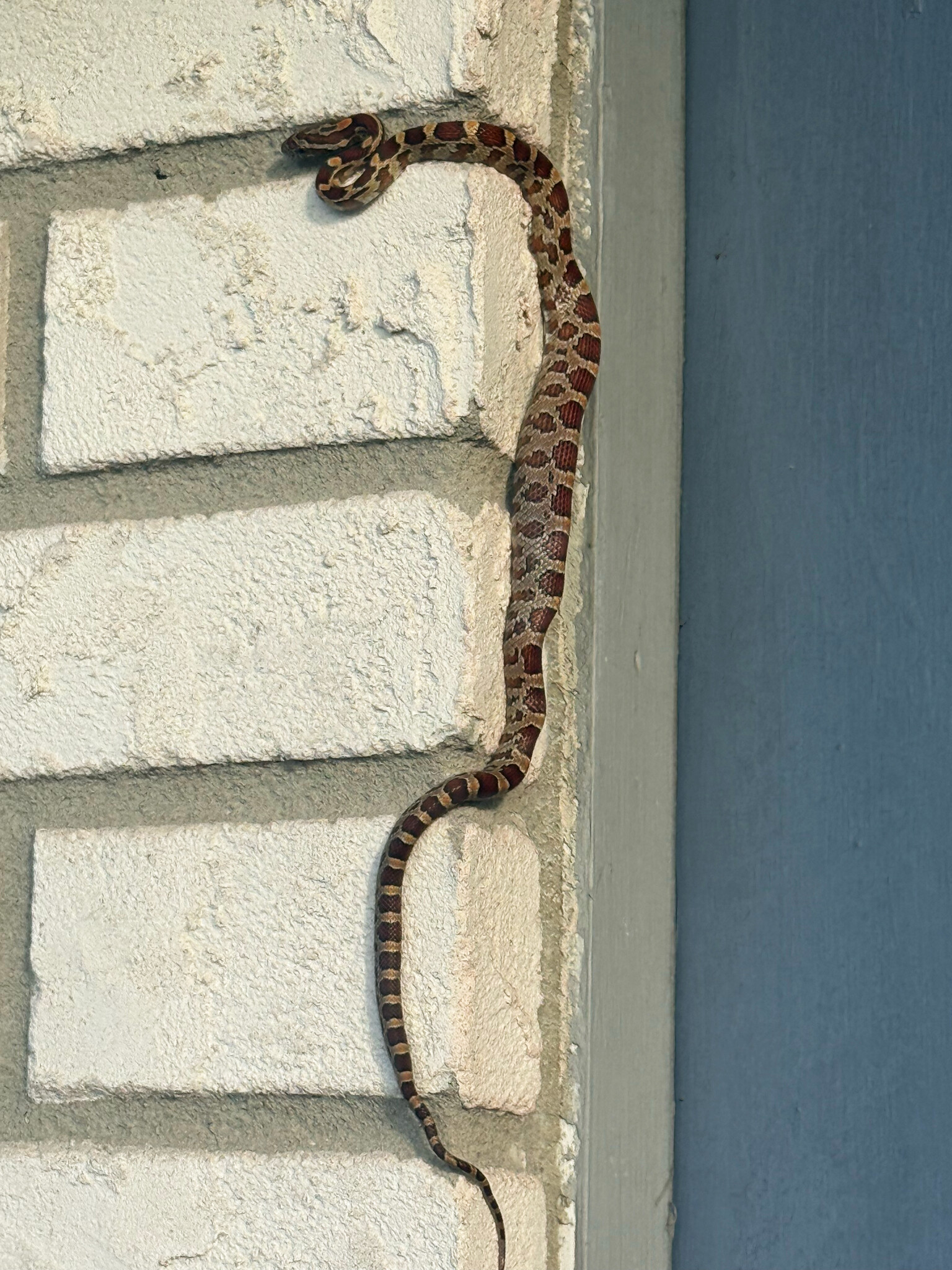
A snake photographed recently climbing the brick wall of a Brevard County home looks a lot scarier than it probably is.
The snake has black-edged, reddish-brown blotches running down a tan-gray body and a spear-shaped marking on its head and neck. Those features match the Florida Museum of Natural History's description of the red cornsnake, also called the red ratsnake. It appears to be one, though an ID from a single photo can't be certain: the cornsnake's black-and-white checkerboard belly, another key field mark, isn't visible.
If it is a cornsnake, it's the kind of neighbor many homeowners would want. Here's what state wildlife officials and University of Florida experts say about living with snakes like it.
Most Florida snakes aren't venomous
Florida has about 50 native snake species, and only six are venomous, according to the Florida Fish and Wildlife Conservation Commission: the eastern coral snake, southern copperhead, cottonmouth, eastern diamondback rattlesnake, timber rattlesnake and dusky pygmy rattlesnake. Only four of those six live in central and southern Florida, UF/IFAS says. Copperheads in Florida are found only in the Panhandle, according to the Florida Museum.
That means most snakes people see are not venomous. But "most" isn't "all," and Brevard does have venomous species. The coral snake and the dusky pygmy rattlesnake are found in every Florida county, the Florida Museum says, and cottonmouths turn up near ditches, ponds and lakes in urban areas throughout the state, according to UF/IFAS.
Rodent patrol
Snakes help keep rodent numbers down, FWC says, and rodents can destroy crops and carry diseases that infect people. Some non-venomous snakes even eat venomous ones.
Cornsnakes eat lizards, frogs, rodents, birds and bird eggs, the Florida Museum says. The museum traces the name to old farm corn cribs, where rats and mice came for the corn and the snakes came for the rats and mice. Cornsnakes are extremely good climbers, the museum notes, and are often found in suburban neighborhoods. Red and yellow rat snakes are often seen on shrubs and fences in residential areas, and they sometimes slip into garages through holes in walls or uncovered roof vent pipes, according to UF/IFAS. Rat snakes that move into attics, garages or sheds when rodents are around tend to leave once the rodents are gone, UF/IFAS says.
Telling it apart from the dangerous ones
Because of its reddish color, the cornsnake is commonly mistaken for a copperhead, FWC says, and sometimes for a coral snake, according to UF/IFAS. Coral snakes are thin snakes with a black snout and rings of red and black separated by narrower yellow rings that go all the way around the body, the Florida Museum says. The cornsnake instead has blotches on its back and sides. Copperheads have a stout body with hourglass-shaped crossbands, according to the museum.
Florida's pit vipers, which include the rattlesnakes and the cottonmouth, have thick, heavy bodies, heat-sensing pits on the face and vertical pupils, UF/IFAS says. But UF/IFAS warns that some non-venomous snakes also have triangular heads, and its advice when you're unsure is simple: give the snake its space. The Florida Museum's snake ID guide lets you filter Florida species by color, pattern and region.
If you see one, give it room
FWC's advice is to stand back and watch. Snakes would rather avoid people and usually flee, and because larger snakes roam widely, one in your yard today may be far away tomorrow, the agency says.
UF/IFAS recommends keeping children and pets back while you try to identify the snake from a safe distance, and not standing between the snake and the nearest cover, since that's where it will try to go, according to its guide. Never handle a snake with bare hands, and never try to handle a venomous one, UF/IFAS says.
Even non-venomous snakes defend themselves. Cornsnakes aren't aggressive, but they will bite if grabbed or pinned, and nearly all bites happen when someone deliberately bothers the snake, the Florida Museum says. A cornered cornsnake may strike and rapidly vibrate its tail, and in dry leaves that can sound like a rattlesnake, according to the Florida Museum and UF/IFAS.
FWC says there is no good reason to kill a snake except in the unlikely case of a venomous snake posing an immediate danger to people or pets. Trying to kill a snake greatly increases your chances of being bitten, UF/IFAS says, and killing non-venomous snakes can backfire, since some eat venomous snakes and help control the rodents that draw snakes in.
Some snakes, such as the eastern indigo snake, are listed as endangered or threatened and are protected, FWC says. FWC permits are required to remove any state-listed species, according to the agency, and it calls trapping, relocating or killing native wildlife a last resort.
Making your yard less inviting
If you'd rather not share your yard, UF/IFAS says the smart approach is to make it less attractive to snakes and the rodents they hunt. Its tips include:
- Keep grass mowed and trim shrubs and tree branches away from the house.
- Keep brush piles away from buildings and play areas, and stack firewood neatly on a rack instead of on the ground.
- Seal gaps under doors and around pipes, wiring and attic vents. UF/IFAS notes that small snakes can fit through an opening no bigger than a pencil.
- Cover roof vents and plumbing vent stacks with hardware cloth.
- Store pet food and bird seed in tightly closed containers, such as a metal garbage can with a secure lid, and keep compost secure from rodents.
- Skip rodent poisons, because poisoned rats can be eaten by pets or wildlife.
Advertised snake repellents don't work, UF/IFAS says. FWC adds that seeing snakes often near your home may mean rodents are around, and that spilled bird seed and pet-food scraps should be cleaned up regularly.
Who to call
For a snake you can't safely leave alone, such as one indoors in a tight spot, UF/IFAS suggests hiring a nuisance wildlife trapper and notes it can be expensive, according to its guide. FWC keeps a Nuisance Wildlife Control Operator directory that can be searched by county and species. FWC does not license the operators on it, the agency says, and most charge a fee, according to FWC. For a venomous snake that seems to be settling in, UF/IFAS advises against trying to kill or remove it without training and suggests contacting state wildlife officials for advice, according to its guide.
Anyone bitten by a venomous snake should seek immediate medical care from a doctor or hospital experienced in treating snakebites, the Florida Museum says. UF/IFAS lists the Poison Control hotline, 1-800-222-1222. In an emergency, call 911.
Have Brevard wildlife photos you took yourself? We'd like to see them.
Photos 1
Tap a photo to enlarge it.
Unknown (received Oct. 27, 2026) A snake that appears to be a red cornsnake climbs a brick wall at a Brevard County home.
Photo: SCW Affiliate Jean
Sources
- Florida Fish and Wildlife Conservation Commission (FWC): Living with Snakes myfwc.com/conservation/you-conserve/wildlife/snakes/
- FWC: Florida's Snakes (brochure, PDF) myfwc.com/media/26730/snake-brochure.pdf
- FWC: Removing Nuisance Wildlife myfwc.com/conservation/you-conserve/wildlife/remove/
- FWC: Nuisance Wildlife FAQs myfwc.com/conservation/you-conserve/wildlife/faqs/
- FWC: Nuisance Wildlife Control Operator directory app.myfwc.com/hgm/nwt
- FWC: Nuisance Wildlife Control Operator Registration myfwc.com/license/wildlife/nuisance-wildlife-permits/trapper-registration/
- Florida Museum of Natural History: Red Cornsnake (Florida Snake ID Guide) www.floridamuseum.ufl.edu/florida-snake-id/snake/red-cornsnake/
- Florida Museum of Natural History: Harlequin Coralsnake www.floridamuseum.ufl.edu/florida-snake-id/snake/harlequin-coralsnake/
- Florida Museum of Natural History: Eastern Copperhead www.floridamuseum.ufl.edu/florida-snake-id/snake/eastern-copperhead/
- Florida Museum of Natural History: Pygmy Rattlesnake www.floridamuseum.ufl.edu/florida-snake-id/snake/pygmy-rattlesnake/
- Florida Museum of Natural History: Florida Snake ID Guide www.floridamuseum.ufl.edu/florida-snake-ID/
- UF/IFAS Extension WEC220/UW258: Dealing with Snakes in Florida's Residential Areas, Identifying Commonly Encountered Snakes edis.ifas.ufl.edu/publication/UW258
- UF/IFAS Extension WEC221/UW260: Dealing with Snakes in Florida's Residential Areas, Preventing Encounters edis.ifas.ufl.edu/publication/UW260
- UF/IFAS Extension UW524: Coexisting with Venomous Snakes edis.ifas.ufl.edu/publication/UW524
Spot something wrong? Request a correction · Our standards
Comments
Keep it friendly. Rude, hostile or personal-attack comments will be removed.