Space Coast air traffic fell more than 60% during Friday's FAA ground stop, our radar data shows
Our Melbourne-area ADS-B receiver counted 444 unique aircraft while the nationwide ground stop was in effect Friday, down 61.7% from a typical weekday evening. Traffic was slow to return after the FAA lifted the stop at 8:19 p.m.
Written with AI assistance, with sources linked below.
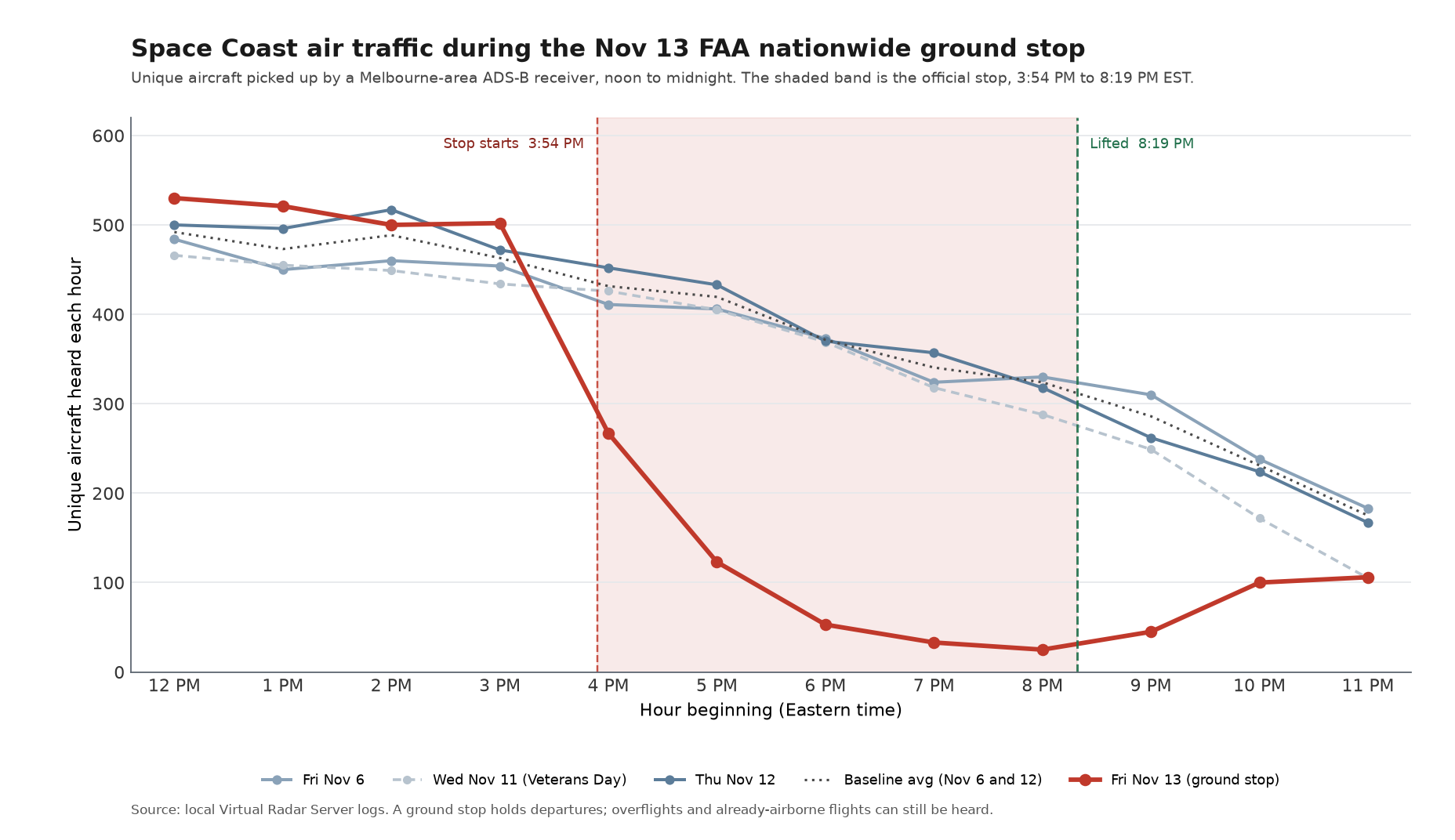
Air traffic over the Space Coast dropped sharply Friday afternoon after the Federal Aviation Administration ordered a nationwide ground stop, according to logs from The Space Coast Wire's own ADS-B receiver in the Melbourne area.
From 3:54 p.m. to 8:19 p.m. EST, the receiver heard 444 unique aircraft, down 61.7% from a baseline of 1,158.5 on comparable weekdays. The stop held departures at every U.S. airport, including Melbourne Orlando International and Orlando International, and was first reported in our earlier story.
The FAA Command Center put the stop in effect at 3:54 p.m. EST, according to Air Traffic Control System Command Center Advisory 111. It canceled the stop at 8:19 p.m., according to Advisory 005. A later notice, Advisory 120, issued at 5:46 p.m., listed the reason as "COMMUNICATIONS FAILURE."
The drop showed up in the first full 15-minute period after the order. From 3:45 to 4 p.m., the count was essentially unchanged from a typical day, at 206 unique aircraft compared with a baseline of 205. From 4 to 4:15 p.m., it fell to 156, down 22% from a baseline of 200.
By the 5 p.m. hour, unique aircraft were down 70.7%. The 6 p.m. hour was down 85.7%, the 7 p.m. hour was down 90.3%, and the 8 p.m. hour, which included the lift at 8:19 p.m., was down 92.3%, with 25 unique aircraft compared with a baseline of 324.
The lowest 15-minute count came from 7 to 7:15 p.m., when the receiver heard 10 unique aircraft, down 93.3% from a baseline of 150.
Commercial flights fell more than general aviation
Commercial flights accounted for most of the decline. During the stop, the receiver heard 316 unique commercial aircraft, down 65.3% from a baseline of 911. General aviation was down 48.8%, at 124 unique aircraft compared with a baseline of 242. Military traffic was too sparse to compare, with 4 unique military aircraft Friday versus a baseline of 5.5.
In this count, commercial includes scheduled airlines, cargo, and some charter or fractional operators that use airline-style callsigns. Commercial traffic went from down 40.8% in the 4 p.m. hour to down 93.4% in the 7 p.m. hour.
Traffic was slow to return
The count did not bounce back when the stop was canceled at 8:19 p.m. From 8:19 to 9 p.m., unique aircraft were down 92.5% from the baseline. The 9 p.m. hour was down 84.3%. From 10 to 11 p.m., the receiver heard 100 unique aircraft, still down 56.7%. From 11 p.m. to midnight, it heard 106, down 39.4%.
In 15-minute slices, the first clear rise came from 9:45 to 10 p.m., when the count reached 30 unique aircraft. From 8:30 to 8:45 p.m., shortly after the lift, the receiver heard only 8 unique aircraft, compared with a baseline of 139.
Melbourne airport and the hours before the stop
Before the stop, from noon to 3:54 p.m., Friday was slightly busier than a typical weekday, with 1,351 unique aircraft, 7% above the baseline of 1,263.
At Melbourne Orlando International Airport, departures during the stop fell to 2, compared with about 15 on the two comparison weekdays, and arrivals fell to 4, compared with about 7.5. Those airport figures are small and include a sizable group of nearby aircraft that could not be classified as arrivals or departures, so they should be read only as a directional sign of how quiet the field became. Before the stop, Melbourne traffic looked normal, with 12 arrivals and 20 departures in our logs.
What the numbers do and do not show
A nationwide ground stop holds departures to U.S. airports. Overflights, flights already in the air, and some inbound international flights can still appear in the feed, so the count never goes to zero.
These figures come from one ADS-B receiver in the Melbourne area, not a national count. The receiver can hear high-flying jets 200 miles or more away, while a low-flying small plane is typically heard only about 40 to 60 miles out. Unique aircraft means distinct transponder codes heard in each time window.
The baseline is the average of Friday, Nov. 6, and Thursday, Nov. 12, at the same clock times. Wednesday, Nov. 11, was Veterans Day and is shown on the charts for comparison, but it is not included in the baseline. There were no receiver gaps longer than five minutes on any of the comparison days. Readers can watch live aircraft, with a delay, on SCW Planes, which draws from the same receiver.
The stop and its cause
Transportation Secretary Sean Duffy said Saturday that Friday's ground stop began after a router installed during an L3Harris copper-to-fiber upgrade at a remote FAA facility started flooding other air traffic control systems. Officials said they had not determined whether the equipment or the installation was at fault, and saw no sign of a cyberattack. No cause has been officially determined, and the FAA said it is doing a root cause analysis. Those details, and the local note that L3Harris is headquartered in Melbourne, are in our earlier story.
Photos 1
Tap a photo to enlarge it.
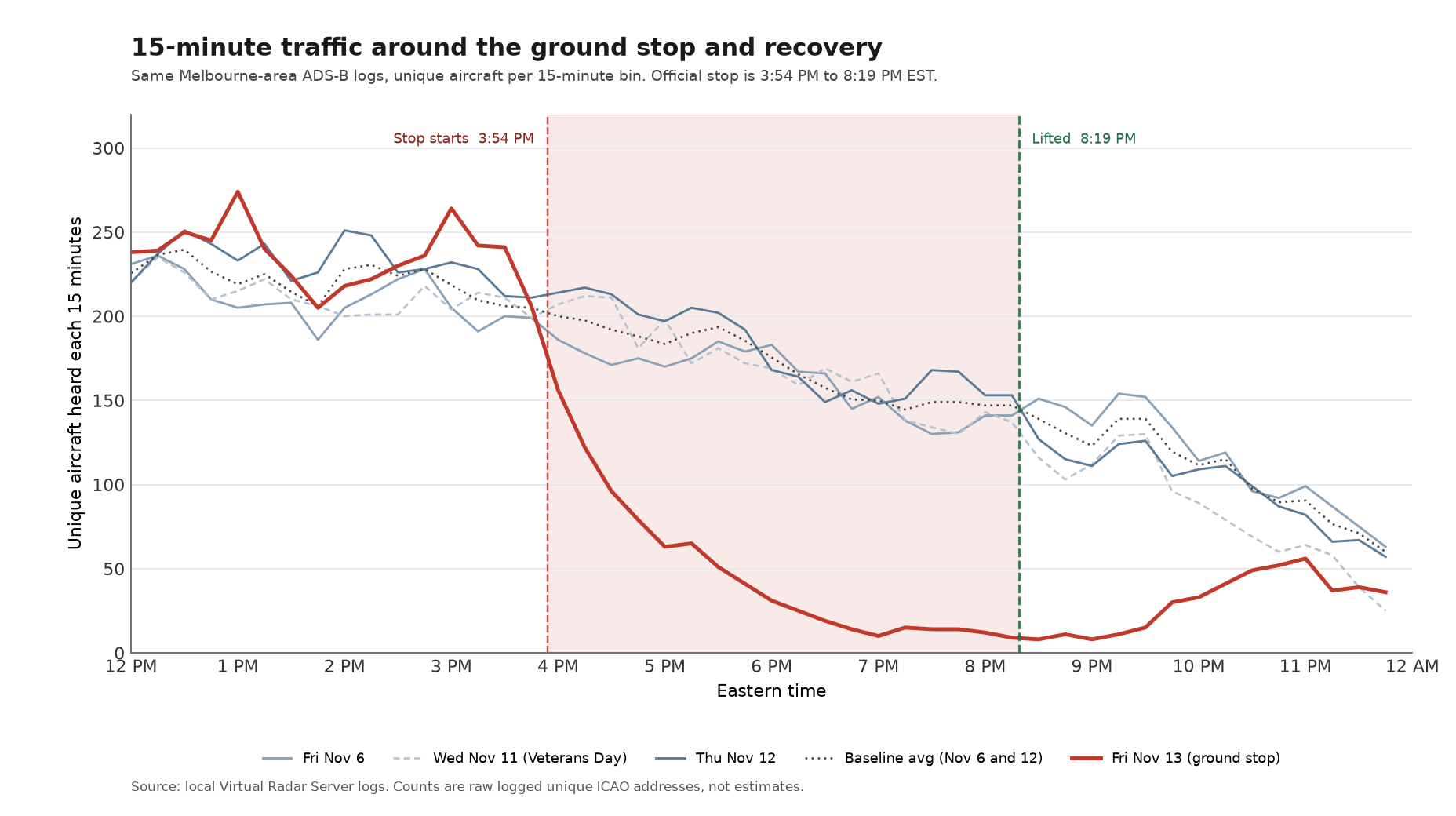
Nov. 13, 2026 The same logs in 15-minute periods, showing the start of the decline after 3:54 p.m., the low point around 7 p.m., and the slow return of traffic after the stop was lifted at 8:19 p.m.
The same logs in 15-minute periods, showing the start of the decline after 3:54 p.m., the low point around 7 p.m., and the slow return of traffic after the stop was lifted at 8:19 p.m. Data: Space Coast Wire ADS-B receiver in Melbourne (SCW Affiliate Jean)
‹ Previous1 / 1Next ›Full size
Sources
- Space Coast Wire ADS-B receiver in Melbourne (SCW Affiliate Jean), Nov. 6, 11, 12 and 13, 2026 spacecoastwire.com/planes
- FAA Air Traffic Control System Command Center Advisory 111 (nationwide ground stop), Nov. 13, 2026 www.fly.faa.gov/adv/adv_otherdis?adv_date=11132026&advn=111
- FAA Air Traffic Control System Command Center Advisory 005 (ground stop canceled), Nov. 13, 2026 www.fly.faa.gov/adv/adv_otherdis?adv_date=11142026&advn=005
- FAA Air Traffic Control System Command Center Advisory 120 (communications failure), Nov. 13, 2026 www.fly.faa.gov/adv/adv_otherdis?adv_date=11132026&advn=120
- The Space Coast Wire, Nov. 13-14, 2026 (ground stop and cause update) spacecoastwire.com/story/faa-nationwide-ground-stop-orlando-melbourne-airports-nov-13
Spot something wrong? Request a correction · Our standards
Comments
Keep it friendly. Rude, hostile or personal-attack comments will be removed.