Cape Canaveral Cygnus launch Sunday, Nov. 29: time and weather
A Falcon 9 is set to lift off at 10:47 a.m. Sunday carrying about 11,000 pounds of cargo to the space station, with the booster landing back at the Cape about eight minutes later.
Written with AI assistance, with sources linked below.
A SpaceX Falcon 9 rocket is set to launch Northrop Grumman's Cygnus XL cargo ship toward the International Space Station on Sunday morning, Nov. 29, from Space Launch Complex 40 at Cape Canaveral Space Force Station.
Liftoff is targeted for 10:47 a.m., according to NASA and SpaceX. The rocket and spacecraft rolled out to the pad on Saturday. If the launch slips, the next chance is 10:24 a.m. Monday, Nov. 30.
What to expect around Brevard
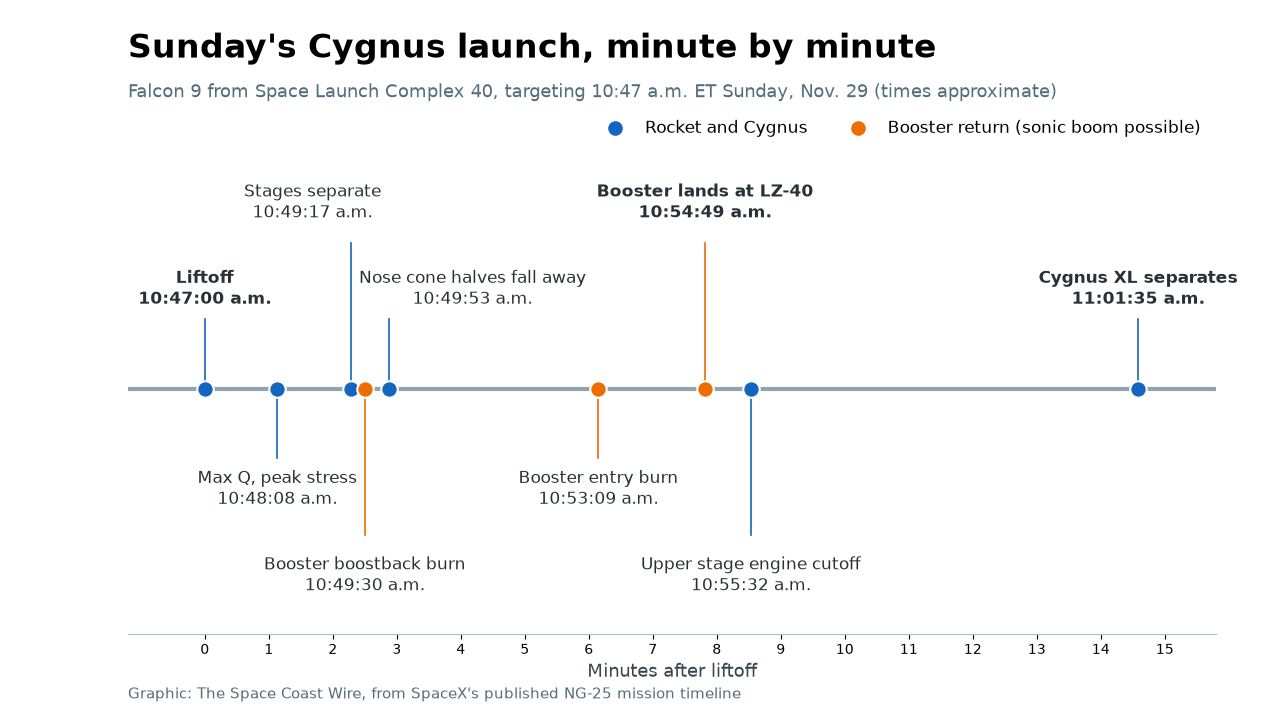
The Falcon 9 first stage is scheduled to fly back and touch down at Landing Zone 40 at the Cape about 7 minutes and 49 seconds after liftoff, SpaceX said. Booster landings at the Cape can send one or more sonic booms across Brevard, so a loud double thump around 10:54 a.m. is likely the rocket coming home, not something to worry about. The timeline at the top of this story shows each step of the flight.
SpaceX said this booster is flying for the ninth time. Its earlier flights include NASA's CRS-34 and CRS-35 station cargo missions, NASA's IMAP mission and two National Reconnaissance Office launches.
About 14 and a half minutes after liftoff, Cygnus is set to separate from the rocket's upper stage and begin chasing the station. Spaceflight Now reports that an on-time launch would put Cygnus at the station early Tuesday, Dec. 1. NASA said astronaut Jessica Watkins will use the station's robotic arm to grab it, with fellow astronaut Luke Delaney monitoring the approach.
Weather: decent odds, but plenty of clouds
NASA said Saturday afternoon that the launch forecast has improved to a 75% chance of acceptable weather, up from 60% on Friday. The main worry is the rule against flying through thick cloud layers.
The National Weather Service in Melbourne expects a mostly cloudy Sunday near the Cape with a high near 75 and light winds. That cloud cover could hide the rocket soon after liftoff for people watching from the beaches and the Indian River.
Things get wetter if the launch slips. Forecasters said in their Saturday afternoon discussion that rain chances climb Sunday night as a weak cold front sinks into Central Florida, with a 40% chance of showers and cloudy skies near the Cape on Monday, the backup day.
What Cygnus is carrying
This is the 25th Northrop Grumman cargo mission under NASA's resupply contract and the third flight of the larger Cygnus XL version. NASA named this spacecraft for Apollo 13 commander Jim Lovell, who flew four missions, including Apollo 8, the first crewed flight around the Moon.
Along with food and crew supplies, NASA's mission overview lists experiments that include:
- Lab-grown muscle tissue used to test whether existing approved drugs could slow muscle loss, a problem for both astronauts and older adults
- Tiny particles built in microgravity that are designed to carry medicine into cartilage and tumors
- Small copies of patients' tumors, grown to study how cancer spreads
- A compact radiation monitor meant for future Artemis Moon missions
- A mostly automated plant growth system aimed at feeding crews on long trips
- A test of robotic welding inside the station's Bishop airlock, using both laser and friction methods
How to watch
NASA's live coverage starts at 10:25 a.m. on NASA+ and its other channels. SpaceX said its webcast begins about 20 minutes before liftoff.
For viewing spots, parking tips and launch-day updates, see our Cygnus NG-25 launch page and our launch viewing guide. Launch times can change on short notice, and SpaceX has the final word on timing.
Sources
- NASA Space Station blog: NASA Rolls Toward Northrop Grumman CRS-25 Launch with Pad Arrival, Nov. 28, 2026 www.nasa.gov/blogs/spacestation/2026/11/28/nasa-rolls-toward-northrop-grumman-crs-25-launch-with-pad-arrival/
- NASA Space Station blog: NASA, Partners' Preps on Track for Sunday Space Station Cargo Launch, Nov. 27, 2026 www.nasa.gov/blogs/spacestation/2026/11/27/nasa-partners-preps-on-track-for-sunday-space-station-cargo-launch/
- NASA: Northrop Grumman CRS-25 Mission Overview www.nasa.gov/missions/station/nasas-northrop-grumman-crs-25-mission-overview/
Show all 6 sourcesShow fewer
- SpaceX: NG-25 Mission www.spacex.com/launches/ng25
- Spaceflight Now: Live coverage of the NG-25 launch, Nov. 28, 2026 spaceflightnow.com/2026/11/28/live-coverage-nasa-spacex-to-launch-northrop-grumman-cygnus-spacecraft-to-the-international-space-station/
- National Weather Service Melbourne: Area Forecast Discussion and point forecast, Nov. 28, 2026 forecast.weather.gov/product.php?site=MLB&issuedby=MLB&product=AFD
Spot something wrong? Request a correction · Our standards
Comments
Keep it friendly. Rude, hostile or personal-attack comments will be removed.