Inside Our Stations: The devices behind The Space Coast Wire's live data, and what's coming next
A tour of the weather, sky, space and radio equipment collecting data around the clock at our stations in Brevard, the long-running datasets we're building, and the new instruments on the way, including a launch camera.
Written with AI assistance, with sources linked below.
Local Weather
Measured on Brevard's beachside by our own weather station
- Wind
- 0 mph N, gusts 2 mph
- Rain today
- 0.00 in
- Humidity
- 70%
- Pressure
- 29.93 inHg → steady
Updated 6:47 AM ET
Our station's outlook (based on local readings, not an official forecast)
Flood Warning in effect: rain on radar near Brevard now. NWS Melbourne, until 12:00 PM ET.
Based on readings to 6:47 AM ET. Rules: 3- and 12-hour pressure change, wind shift and humidity/dew point trend. For official forecasts and warnings see the National Weather Service in Melbourne.
Sun
Sunrise 6:43 AM · Sunset 5:32 PM
Moon
Waxing Crescent, 10% lit
Sun and moon times are calculated on our server for Brevard's beachside. Daily weather log, records and forecast →
Look up from almost any page on The Space Coast Wire and you'll find a reading that came from our own equipment. A weather station, an air quality sensor, a radiation monitor, a satellite dish, a magnetometer, a radio meteor detector and a handful of radio receivers run around the clock at our stations in Brevard. They measure the air, the sky, the ground's magnetic field and the traffic overhead and offshore.
Here's a tour of what we run, what each device measures and where you can see it. All of it is in one place on Our Stations.
Weather and environment
Weather station. This is the heart of the network. Our beachside station measures temperature, humidity, dew point, wind speed, gusts and direction, rainfall, air pressure, UV and sunlight strength. Those readings feed the Weather Station, Rain Meter, Wind & Gust Meter, Barometer, Muggy Meter, Beach UV Meter and Sunshine Meter cards, and the station keeps its own daily log and records. See it: Weather
Air quality sensor. Two laser particle counters measure fine particles (PM2.5) in the air every two minutes. We show the result on the EPA's Air Quality Index. See it: Air Quality
Night sky light meter. This meter measures how dark the sky is overhead. It takes a reading about every 30 seconds through the night and charts the readings against the Moon's phase and height. It is a light meter, not a camera. See it: Night Sky Light Meter
Radiation monitor. Our own Geiger counter reports background radiation every couple of minutes, in counts per minute and microsieverts per hour, alongside the typical natural range. See it: Radiation Monitor
NOAA Weather Radio receiver. A receiver listens to NOAA Weather Radio day and night as a backup for official alerts. See it: Weather Alerts
Weather Matrix. This view brings our live feeds together on one screen, along with outside lightning data and the Melbourne airport's conditions. See it: Weather Matrix
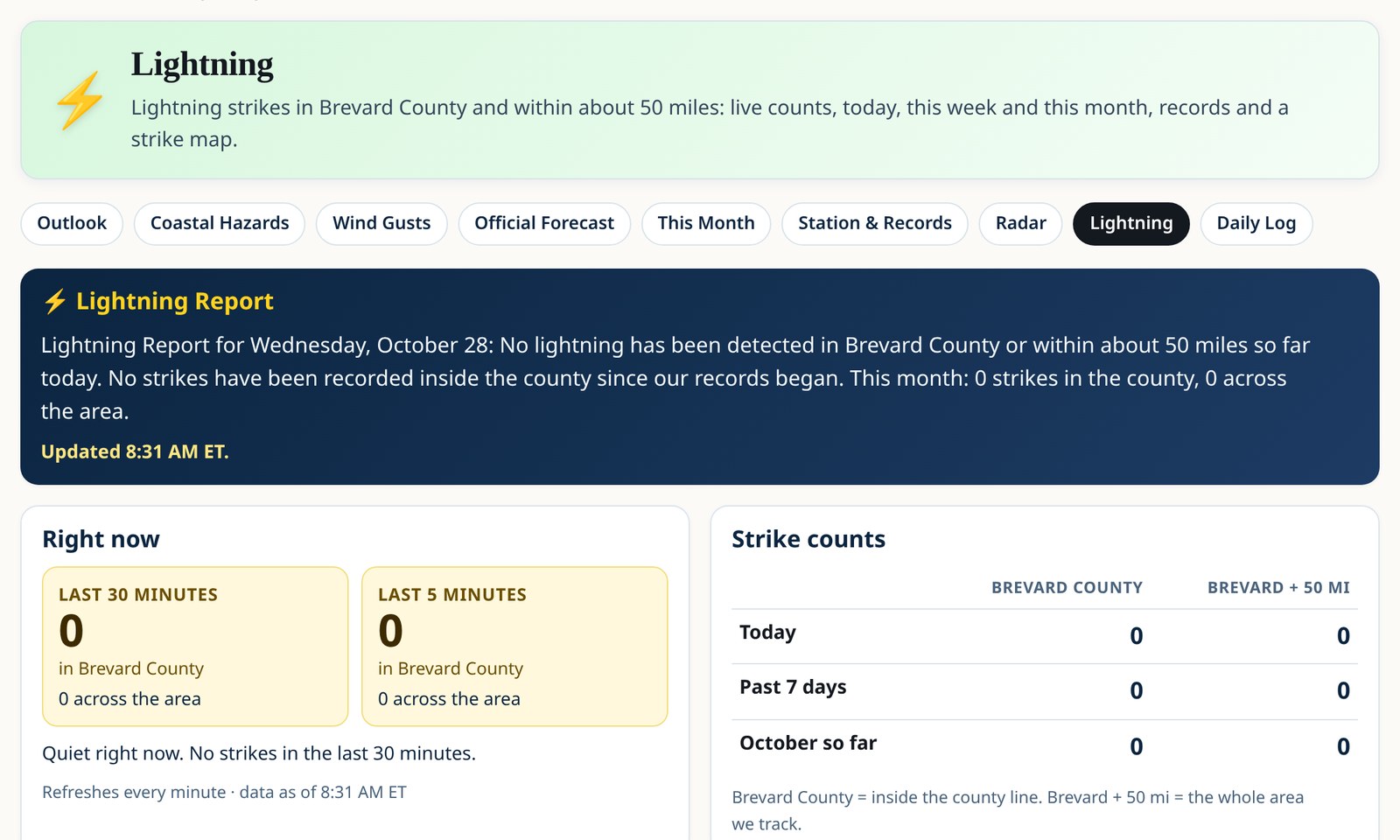
Lightning (outside data). Our Lightning page shows live strike counts, a strike map, the nearest-strike distance for local towns and running records kept since Oct. 28, 2026. These numbers come from a commercial lightning network, not our own equipment, and we label them "Outside data." See it: Lightning
Space and sky
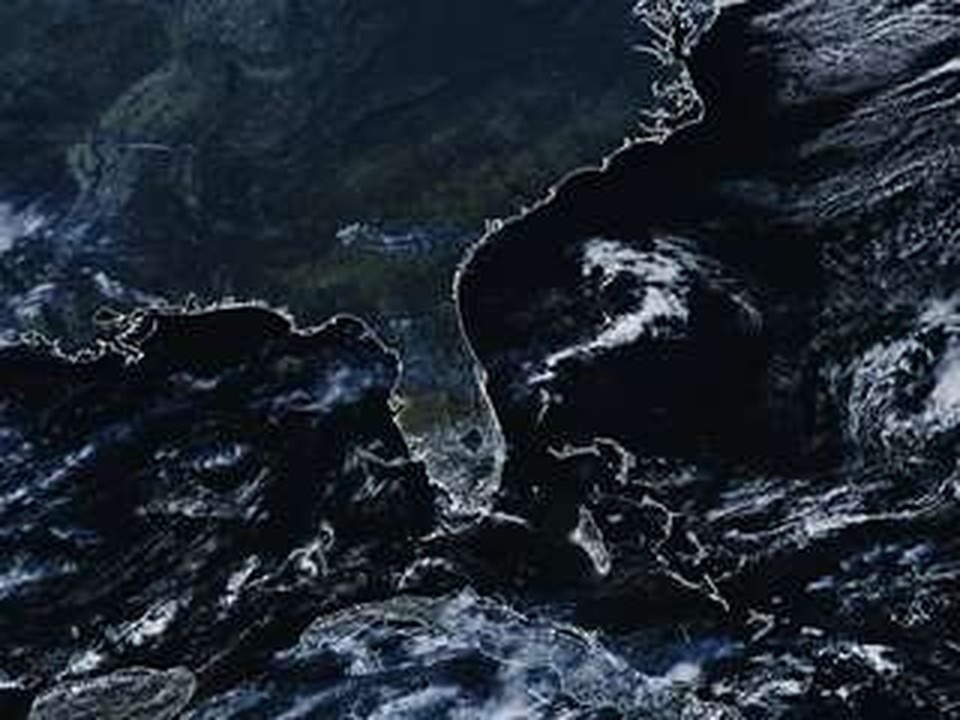
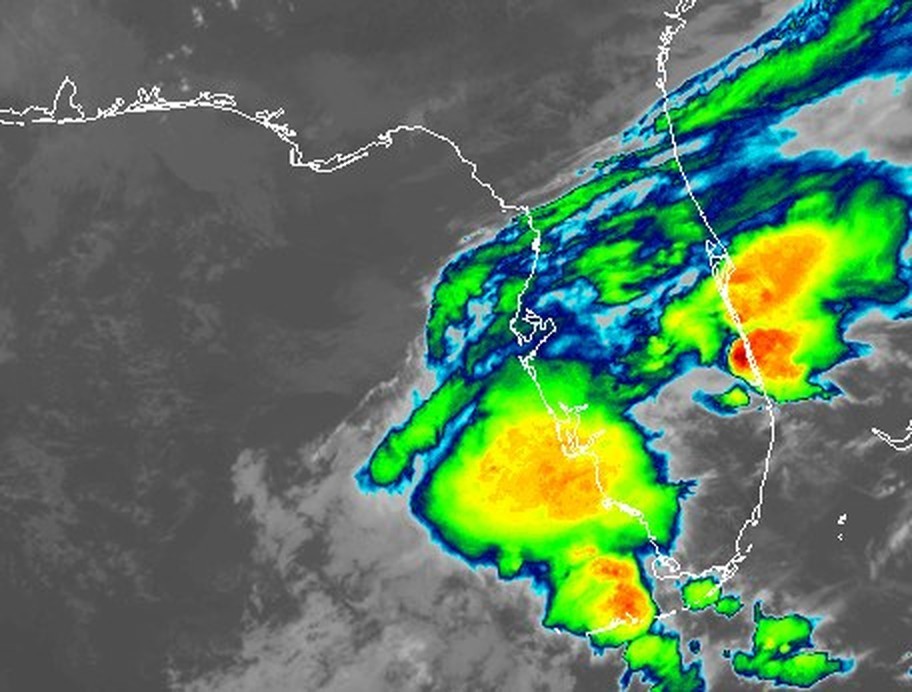
Satellite dish. Our dish receives images straight from NOAA's GOES-19 weather satellite, which watches Florida and the Atlantic from about 22,000 miles up. Images are received by SCW Affiliate Jean. We post dated, hand-reviewed selections, so these are not live views. See it: Live From Our Dish
Magnetometer (experimental). This sensor records the local magnetic field around the clock. The page shows how the readings rise and fall over time. These are raw readings that haven't been calibrated yet, so we don't use them to forecast storms or aurora. See it: Magnetometer
Radio meteor scatter monitor (experimental). When a meteor burns up high overhead, it can briefly bounce distant radio signals down to us. Our monitor listens for those "pings" and saves a trace of every possible echo. On Nov. 8, for example, it flagged 192 possible echoes. Each day gets a plain-language recap, and any time the detector was down is marked as a gap, never as a quiet night. These are possible echoes, not confirmed meteors. See it: Radio Meteor Scatter
Aviation, marine and radio
Plane radar receiver. Our receiver picks up the position broadcasts that most aircraft send out (ADS-B) and puts them on a live map about a minute behind real time. See it: Plane Radar
Boat radio receiver. A marine radio (AIS) receiver hears ships and boats that broadcast their position. Many small boats don't carry AIS, so this isn't every boat on the water. It has logged every boat it heard since Oct. 31, 2026, with a daily count. See it: Boat Radio
Mesh radio node. Our off-grid mesh radio node is part of a community radio network that passes text messages from radio to radio with no cell service or internet needed. You can even send us a tip over it. See it: Wire on the Mesh
The data lakes we're building
Behind every one of these pages is a growing local archive of our own measurements. We call these our data lakes. Each device saves what it actually measured, with the time it measured it, into its own database or log here in Brevard. The meteor monitor keeps every possible echo it hears. The boat radio keeps a day-by-day count. The light meter keeps every 30-second reading. The weather station keeps a daily log, and the lightning page keeps running records.
The longer these records run, the more useful they get. Over months and years we'll be able to compare this November with next November, see how the night sky changes with the seasons, notice when the magnetic field or meteor activity looks unusual, and look back at how storms, launches and traffic played out across the Space Coast.
We hold ourselves to a few rules:
- No made-up numbers. If a device goes offline, the gap stays visible. We never fill it in or guess.
- Freshness first. Every card shows when its reading was taken. If a reading goes stale, the card says so.
- Honest labels. Experimental instruments are marked experimental, and outside data is marked as outside data.
Coming soon
There's more on the way. We've already bought each of these devices. The dates below are our best estimates and will move with shipping and setup.
- All-sky night camera. A weatherproof camera with a 180-degree fisheye lens and a heated dome that sees the whole sky at once. It will catch meteors and fireballs, track cloud cover and make overnight time-lapses, and it pairs naturally with the radio meteor monitor and the sky light meter. Status: ordered Nov. 7, waiting to ship from Europe. Estimated go-live: December 2026 (estimate).
- Seismograph and infrasound monitor. This instrument senses tiny ground vibrations and very low-pitched sound that people can't hear. That could include distant earthquakes, and possibly the rumble of rockets launching from the Cape. Status: shipped and in transit. Import duties were paid Nov. 9, and the shipper expects it to continue toward delivery within 24 to 48 business hours. Estimated go-live: late November 2026, after setup and testing (estimate).
- Launch camera (and palm tree cam). A 32x zoom camera that will follow rocket launches from the Space Coast. Between launches it will keep an eye on a palm tree as our just-for-fun "palm tree weather station." You'll be able to see at a glance how hard the palm is swaying in the wind and whether it's sunny or raining. It's a playful look at conditions right now, not an official forecast. Status: the camera has arrived and is waiting to be mounted and set up. Estimated go-live: December 2026 (estimate).
- Smart telescope. An automated telescope and camera that finds and tracks targets on its own. We'll use it to bring you our own photos of the Moon, planets, nebulae and galaxies from Brevard skies. Status: pre-ordered Nov. 8; the item is backordered and has no ship date yet. Estimated go-live: early 2027 (estimate).
When each one goes live, it will get its own card on Our Stations and its own page, with the same freshness labels and no made-up data.
Our weather and lightning readings, and the palm tree cam once it's live, are for information only and are not for safety decisions. Follow National Weather Service warnings, and when thunder roars, go indoors.
See it all now: Our Stations
Sources
- The Space Coast Wire: Our Stations spacecoastwire.com/stations
- The Space Coast Wire: Weather Matrix spacecoastwire.com/weather-matrix
- The Space Coast Wire: Air Quality spacecoastwire.com/weather/air-quality
Show all 13 sourcesShow fewer
- The Space Coast Wire: Night Sky Light Meter spacecoastwire.com/sky-light-meter
- The Space Coast Wire: Radiation Monitor spacecoastwire.com/weather/radiation
- The Space Coast Wire: Lightning spacecoastwire.com/weather/lightning
- The Space Coast Wire: Live From Our Dish (GOES) spacecoastwire.com/goes
- The Space Coast Wire: Magnetometer spacecoastwire.com/nextmag
- The Space Coast Wire: Radio Meteor Scatter spacecoastwire.com/meteors
- The Space Coast Wire: Plane Radar spacecoastwire.com/planes
- The Space Coast Wire: Boat Radio spacecoastwire.com/boats
- The Space Coast Wire: Wire on the Mesh spacecoastwire.com/mesh
- National Weather Service lightning safety www.weather.gov/safety/lightning
Spot something wrong? Request a correction · Our standards
Comments
Keep it friendly. Rude, hostile or personal-attack comments will be removed.